An open-source pipeline that turns a standard MRI scan into a simulation-ready finite element head model.
PARS converts a T1-weighted MRI scan into an anatomically detailed, subject-specific finite element head model, with no manual segmentation and no proprietary meshing software. It reconstructs the meninges algorithmically and controls mesh quality automatically, making subject-specific and cohort-scale head modelling reproducible. Released open source and demonstrated across 23 subjects.
Turning a medical image into a subject-specific finite element model has been a long-standing bottleneck in brain modelling. Existing workflows depend on manual image segmentation, proprietary meshing software, and labour-intensive repair of the meninges and tissue interfaces. That combination limits reproducibility and makes cohort-scale studies impractical.
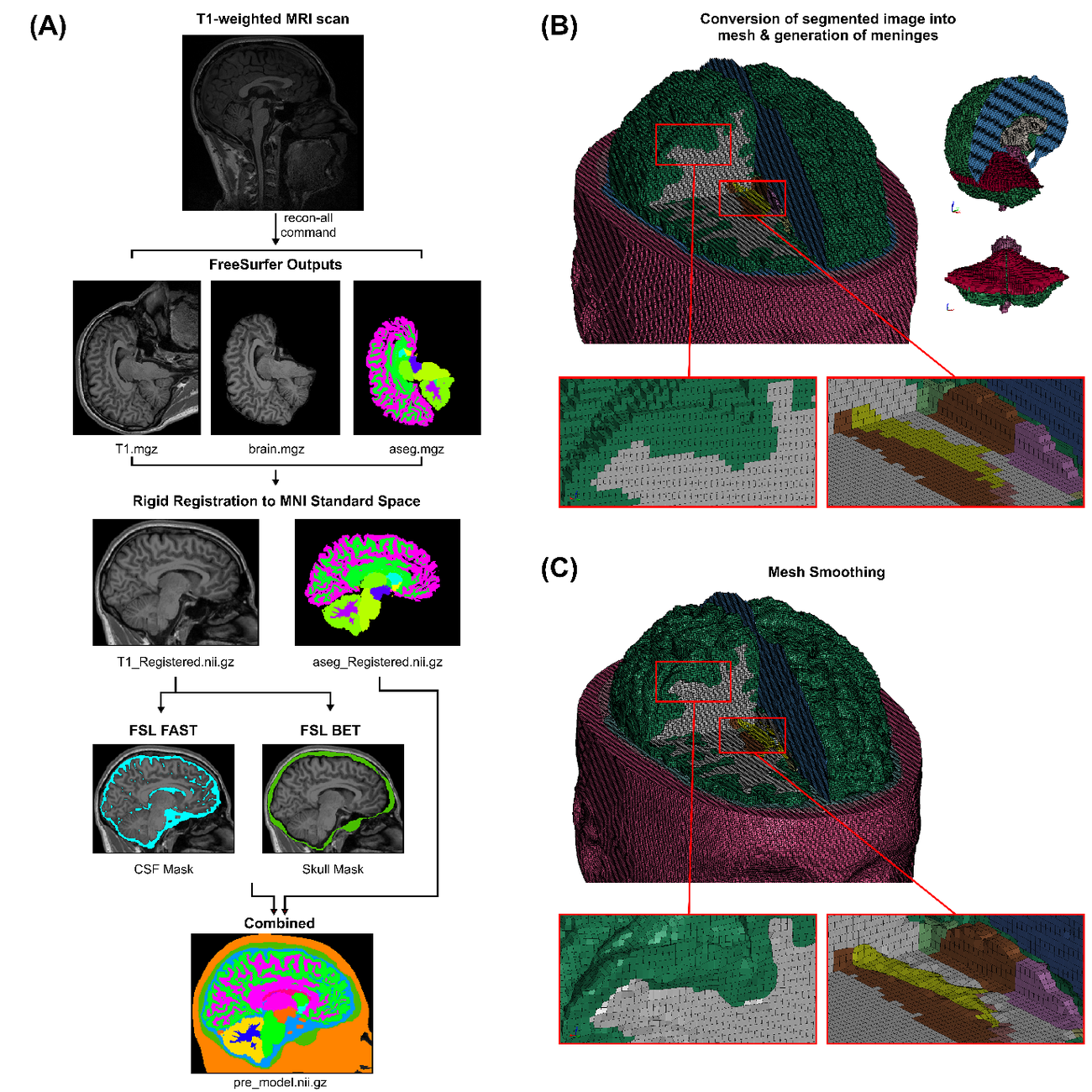
PARS is a fully automated, open-source pipeline that converts a T1-weighted MRI scan into a simulation-ready head model. It combines anatomical parcellation with tissue maps and uses iterative neighbourhood-based reclassification to produce a gap-free whole-head label volume. That volume is converted directly into a hexahedral mesh, augmented with algorithmically reconstructed falx, tentorium, pia and dura mater, then refined by Laplacian smoothing under a node-locking scheme that controls element quality and the explicit-solver stable timestep.
Full pipeline from MRI through segmentation, registration, meshing, meninges and smoothing.
PARS was demonstrated across 23 subjects spanning a range of cranial anatomy, producing a model in under 40 minutes per subject. It is released openly under a BSD 3-Clause licence with full documentation, so other groups can build subject-specific head models without proprietary tools. The models it produces support work across traumatic brain injury, hydrocephalus, and other neurological conditions.
A PARS-generated head model under simulated heading impact, coloured by predicted 1st principal strain in the brain.